Small Mysteries

silver bauble and cm 1aFive Christmases ago, while I was passing through a park where I often walk, I noticed that someone or several someones had quietly decorated three or four of the trees with Christmas ornaments. Coloured baubles touched with frost on a tree heavy with hoar frost. Very, very pretty.

A few Christmases later, ice lanterns appeared mysteriously up and down the boulevard on my street, about one per house. After dark on Christmas eve another unknown someone moved quietly but quickly from one to the next, lighting them. They burned throughout the night and well into Christmas day. And then the mysterious someone lit them again Christmas night.

These gestures on the part of people I don’t know gave me and my neighbours a huge amount of pleasure. In a way, I don’t want to know who the unknown perpetrators are. I hesitated before posting about it here in case too much attention might take some of the magic out of the experience. Because magic it is. The decorations are back on the trees again this December. And I’m really hoping the lanterns will be back, too. But this year, for the first time, we’ll be contributing some of our own.

This Christmas I’ll raise a glass to my wonderful, unknown neighbours who bring light and colour to the bleak midwinter. Merry Christmas and Happy Holidays to all.

Guest Blogger, John Baillie

It’s a pleasure to introduce my first guest blogger, John Baillie. John has two traditionally published books: a collection of poetry titled Destination Mutable and Midnight’s Delight, short stories featuring enigmatic Winnipeg private investigator Jason Midnight. In recent years he’s spent an egregious amount of time adapting the reality television elimination show concept to literature on his popular bi-weekly Reality Fiction blog. Jason Midnight will play a central role in the third Reality Fiction Contest, debuting on December 29th this year at realficone.blogspot.ca.

Also find John’s Baillie’s blog of reflections on the literary life, “Sundog Rising” at http://dogrise.blogspot.ca

Winnipeg: A Real and Imagined Geography
by John Baillie
R Beaubien Townlight 1 sharp, B & W

Renee Beaubien

When Midnight’s Delight was published in 2006 (now out of print) and placed on the Internet as part of the fledgling e-book movement, my editor told me it’s great that your book is set in Winnipeg, but you have to make Winnipeg come alive for the world. Imagine someone reading your book on a computer screen in Pakistan.

I don’t know if Midnight’s Delight ever made much of an impact in Pakistan. But also through the magic of the Internet, I did discover it was picked up as a recommended travel read on a Chinese airline. So the editor had a point.

But you know what? It’s tricky pinning down a city.

Twelve of the thirteen Jason Midnight stories in Midnight’s Delight are set in specific locations in Winnipeg. However, thanks to the enormous time delay that occurs between writing and publishing, some of the locations I wrote about didn’t exist anymore by the time the book came out. There was a scene in an early draft of one story very specifically set in a store in Polo Park that was gone before the book was accepted for publication. What’s a poor writer to do? Put a disclaimer at the beginning of every story saying “The events that follow happen in the Winnipeg of June, 1991. More or less the third week.” Changing the month and year as necessary as locations shift and disappear from tale to tale?

Catherine had the right idea setting Put on the Armour of Light in 1899 — even if she did fudge the geography a little bit for the necessities of the plot. She’s dealing with a Winnipeg fixed in time. And not one where Chinese tourists will easily be able to challenge any relocations she might sneak in.

I found my answer was to create a uniquely Jason Midnight Winnipeg. Sure, sneak in the odd fixed real landmark that you hope isn’t going to change any too quickly. But other than that, take the essence of what’s out there, shift it a bit to make it your own, and convey the city more through how the eyes and the mind of the protagonist perceive it than through mappable geography.

I ended up writing this promotional bit to go with Midnight’s Delight to illustrate the point:
Winnipeg — The Big Mosquito — Winnipeg —

If you don’t know it, you’ve never walked an empty downtown city street on a Sunday afternoon …

Winnipeg — Home of the Midnight Detective Agency — Home of Jake Fincowicz who can change his name on a whim to Jason Midnight and spend the rest of his life living up to that mistake. Where a Private Eye can put a sign on his door saying “No Case Or Solution Too Ridiculous To Be Considered” … and they aren’t.

Jason Midnight’s Winnipeg — where he can hear the wilted strains of the Jarvis Avenue Allstars belting out cool swing on an even colder night from the Pungent Onion Club as the girls strip right down to the bone; where a dame can get so deep into your head she can rewrite your internal musical soundtrack; where the puck never crosses the goal line in a hockey game without the right hoodoo on it; where the ghosts of ancient killers haunt every shadow of the old Exchange District on the wrong wintery nights; where the hookers run with the demons and the demons haul you off into your inner fractal at an odd angle in the alley behind the bar; where the Devil runs the only serious betting game in town; and where certain rich women can be had for a chocolate bar — the right chocolate bar. Winnipeg.

Jason Midnight’s home — Jason Midnight’s horror —
Jason Midnight’s Delight.

Take a slow left turn into Jason Midnight’s Winnipeg. You’ll never be blown past Portage and Main the same way again.
The idea must have worked. As I said, China was willing to fly by it.

A Launch to Remember

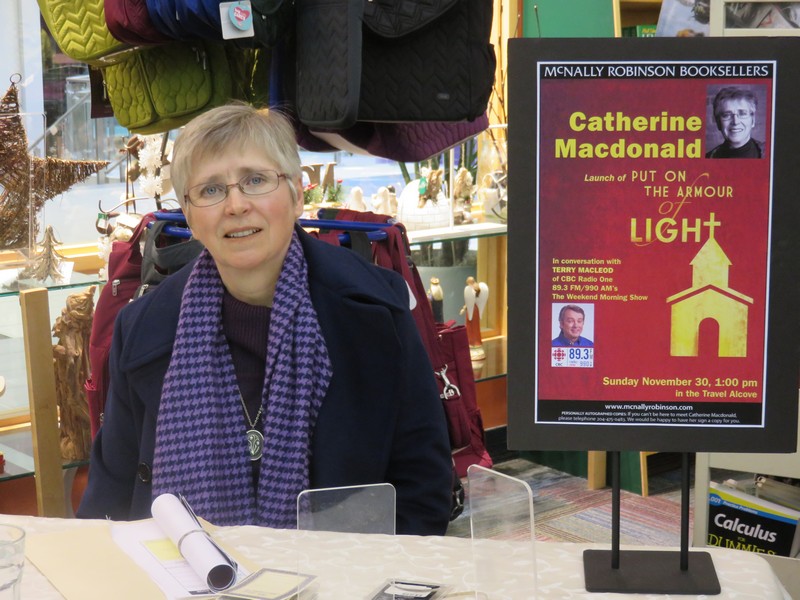
CM and poster McNally Robinson 3I’m still gobsmacked by how amazing the book launch was on Sunday. Because of all of you who came out on a frigid afternoon to help me launch the book in style, and who bought a copy, or even several copies, Put on the Armour of Light is number 1 in the paperback fiction category of McNally Robinson’s bestseller list for the week of Nov. 30. Thank you, one and all. I may descend to earth some time next week.

And if you still want a copy, you can get it in Winnipeg at McNally Robinson, Whodunit, Chapters and all three Winnipeg locations of Costco.

Missed the launch? Then come out to my reading and signing at Whodunit on Sunday, Dec. 7 at 3pm.

More from Whodunit Bookstore

jackandwendy1In honour of the Whodunit Bookstore’s 21st anniversary celebrations, I asked owners Jack and Wendy Bumsted to sit down to an e-interview.

Find Whodunit Bookstore on the web here: http://www.whodunitcanada.com/home

And read the interview below. Jack and Wendy’s individual answers to my questions are indicated by their respective initials.

CM: What do you enjoy most about being being mystery booksellers? And what do you enjoy least?

WB: Talking about a genre which interests us, and is of interest to the customers is wonderful. As the vast majority of our customers are only visiting because they like the genre, the exchange of knowledge is very easy and pleasant between us and them. Not only do we introduce people new authors, we also occasionally get introduced to new authors ourselves; customers who visit other countries often give us the scoop on who is being sold at stores they visit abroad.

What I enjoy least is the paperwork. There is a relatively large amount of paperwork involved in bookselling which we largely overlooked as outsiders. That paper is still the major form of communication between us and the publishers, has meant we are unable to streamline the process as much as we would like.

JB: The customers are the best part of running the shop. We have a wide range of customers from different backgrounds and interests, all of whom are interesting to chat with. As we have gotten to know them more and more, we have come to appreciate them as people as well as customers.

Getting books into the store is the least pleasant part of the job. The trouble we have with publishers, distributors, and couriers is constant. Publication date changes, importation battles, and delivery problems make fulfilling the expectations of our customers more difficult everyday.

CM: Here I show my own interests. Are mystery books set in Canada an easy or a hard sell?

WB: Both. Some customers (local and visiting) want to read Canadian, or books set in Canada by Canadian authors. We have customers who want Winnipeg, or Canadian books. But the fact that a book is set in Canada is not a major selling feature for the majority. For us, we just want to sell good mysteries, so we have abolished Local and Canadian subsections. They are integrated into the general population.

JB: I agree. Most of our customers are not especially interested in local/Canadian authors. The authors that transcend that designation however, are able to take advantage of being from Winnipeg to increase their popularity among our clientele.

CM: What trends in mystery writing do you find most striking, say, in the last decade?

WB: The growth of Scandanavian writers, obviously. While some writers like Jo Nesbo were published prior to the “Girl with…” books, Stieg Larsson gave an impetus to the increased translation of more and more writers. It has also led to a large number of previously translated authors, for example, the Swedish writing team, Maj Sjowall and Per Wahloo, being reissued after many years in the shadows.

JB: Increase in translated works in general has been rising, in fact. We now have 4 to 5 new titles each month that have come from non-English parts of the world. Not only are most of them exceptional works of fiction, they often also provide new perspectives on crime fiction, and the world. They are full of new information.

CM: What trend in recent mystery writing or publishing do you find most annoying?

WB: Two things: first, translations being published out of the original order. Anne Holt in particular, but Jo Nesbo and many other writers have been given the same treatment. A more recent example might be Michele Giuttari, who had 5 books translated and released within weeks of one another, and 5 and 6 arrived before 3 and 4!

Secondly, series in general are a growing problem. One of the hardest things is when a customer discovers a new author, and wants to read the series from the beginning. If this is a long running series, or one that really needs to be read in order (of which there are also a growing number) this is a particular problem. Finding the earlier books, in any format, new or used, can be a real challenge.

JB: The franchise is an extension of the series problem. Publisher’s and estates will sometimes not let an author die. Listed either as collaborations, or with the original author’s name on the cover in the possessive, these books often do not measure up to the original, and in my opinion, should not be encouraged. It is especially problematic when the new author has an independent track record which is being disrupted in order to continue the franchise.

A Tale of Two Grandmothers

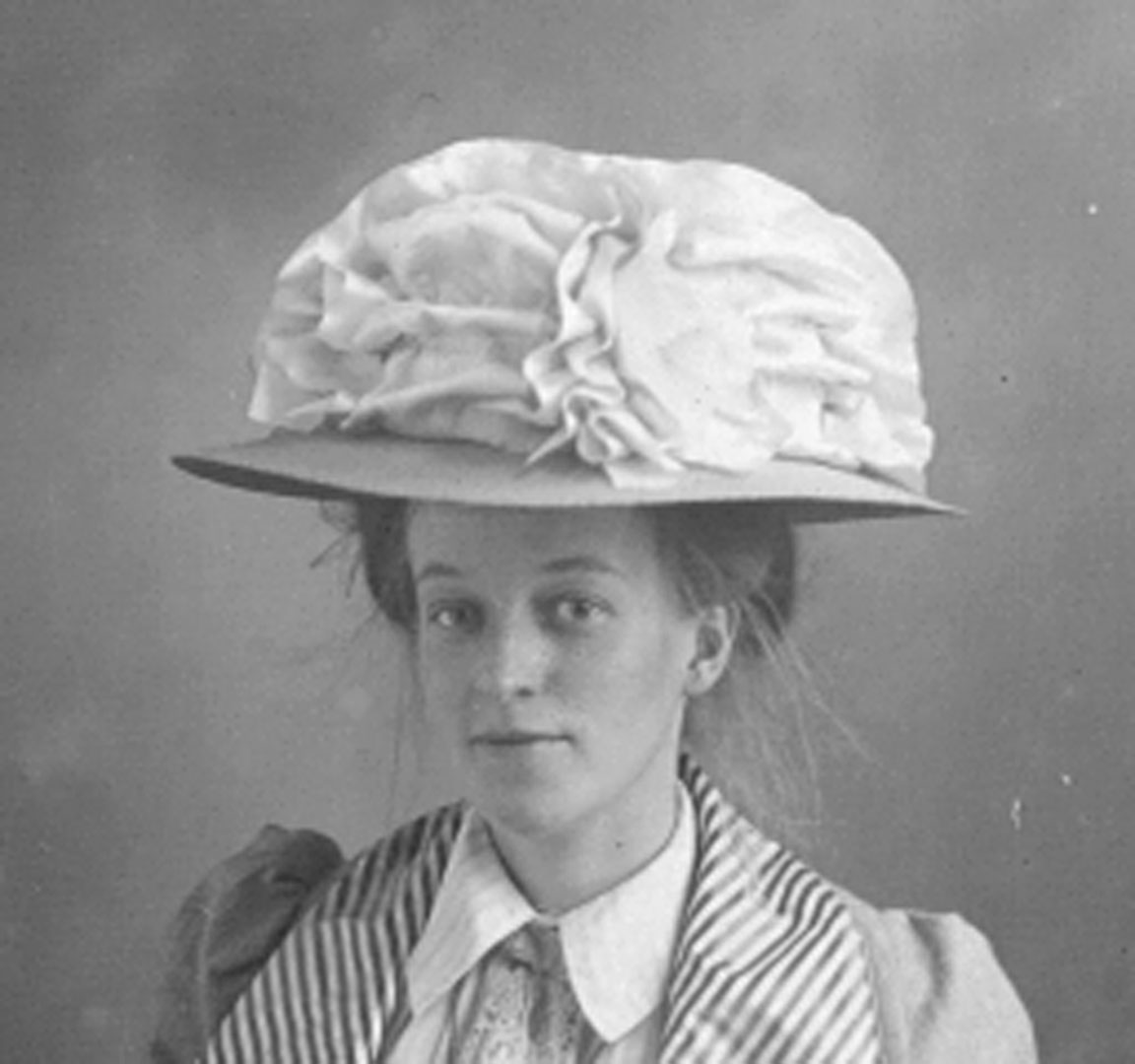
Scanned DocumentThis lovely woman in the magnificent hat is my friend Louise’s grandmother, who was raised in London, England, and after marrying, lived on a farm near Clearwater, Manitoba.

Hats do not figure much in the plot of my book, Put on the Armour of Light, which is set in Winnipeg in 1899. But my female characters would certainly have worn one whenever they ventured outside the house.

If  being hatted was so obligatory, how did women like Louise’s grandmother, who lived in the country and far away from millinery shops, acquire hats like these? The answer is: they attended “openings”—that is, demonstrations of that season’s hats—put on in the local general store by women like my grandmother. Louise, who is editing her father’s history of the town of Clearwater, found this report in the Crystal City Courier of May 3, 1906 about an “opening” in Clearwater:

Miss Sheratt, of Pilot Mound, held a Millinery Opening here on the 26th and 27th and naturally, those were busy days with the ladies, and the display of hats was so tempting that not a few of our young men wished they could indulge.

My grandparents owned the general store in Elgin, Manitoba, and my grandmother had been trained as a milliner at the Eaton’s store in Toronto. Each year she would travel to the towns up and down the railway line from Elgin, showing off the new hats and taking orders for them. Women would order a basic shape of hat and then request my grandmother to trim it with feathers, lace, netting, ornaments or anything else that would make the hat unique for each customer. Eaton’s could do this as well, through their famous catalogue, but the catalogue could not rival my grandmother for personal service.

Take a look at the hats in the 1899-1900 Eaton’s Catalogue here:

https://archive.org/stream/eatons1899190000eatouoft#page/n35/mode/2up

Alison Preston’s New Book

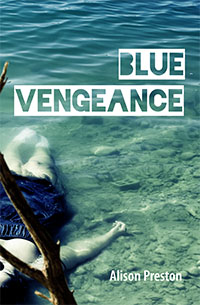
4237 Blue Vengeance_m2.inddIt’s a pleasure to talk about a new book, one that has just been launched. Blue Vengeance, Alison Preston’s seventh novel, takes us once again to Norwood, the Winnipeg suburb where she grew up and where she still lives. This time, the action takes place in 1964 and centres on 13 year old Danny Blue, who embarks on a quest to make the person responsible for his sister Cookie’s death pay for the crime.

Preston’s take on Norwood is deadpan funny and more than slightly askew. But her characters struggle with devastating issues, making choices that are often messy and morally fraught. Though her books have mysterious elements, they are much less conventional than the “mystery” label would suggest and have an elusive quality that is intriguing.

Find Alison Preston on the web at http://www.alisonpreston.com/

And read on as Alison participates in an e-interview with me.

CM: What is it about 1964 that made you want to set the book in that time?

AP: When I realized the book was going to be about young teenagers, I knew I had to set it in the past. I didn’t want the action and interaction to be built around hand-held electronic devices.
And then when I realized the exact age of the characters (Danny thirteen turning fourteen, and Janine fifteen turning sixteen), 1964 muscled its way in. That was the year that I turned 15, and it is vivid in my memory, partly because of the Beatles turning up on Ed Sullivan, partly because that was the year of my first real boyfriend – the one with whom the kisses really counted – and the serious heart-break that went along with that.

CM: How did you get into the head of a 13 year old boy from 1964? Was it totally an act of imagination? Or did you do research?

AP: I think it was an osmosis kind of thing. I have a brother; I’ve always had a brother. I played with him, hung around with him, followed him, pestered him. I insinuated myself into his friendships.
And I always had friends who were boys. And remained so. I think deep down we’re all still young teenagers.
I researched practicalities with my brother, like with slingshot usage. He was flabbergasted by my ignorance. So I incorporated that into the book with Paul’s amazement at Danny’s stupidity (not knowing he couldn’t hit moving objects) and his disgust with the feebleness of Danny’s shooting at leaves. And with another slingshot–related revelation that comes towards the end of the book. I won’t divulge that one.

CM: One of the pleasures of Blue Vengeance is that some characters from your other books make strategic appearances. The noble Frank Foote, your usual hero, is the person who finds Cookie Blue’s drowned body. And Morven Rankin from The Girl in the Wall provides information at a key moment, like a 1964 Delphic oracle. Do you get as much pleasure from the walk-ons of these characters as your readers?

AP: I do, indeed, get pleasure from placing characters from other books in a new novel. And thank you for saying that there’s a possibility that readers may enjoy this too.
I was worried that no one would like Morven Rankin (from “The Girl in the Wall”). When a friend mentioned that she liked her a lot and hoped I would put her in another book I was ecstatic. At first Morv just had a tiny role in “Blue Vengeance”: the scene in which Danny and Janine walked past her and her brother George, and neither she nor Janine said hello. But then I enlarged her presence with the unpleasant scene in the gymnasium and then further to the Delphic oracle. I loved doing that.

CM: You often write about children grappling with very grown-up problems on their own. And these children are very astute observers of adult foibles. What attracts you about the world of childhood?

AP: I identify with children grappling with grown-up problems on their own. At the risk of sounding like I had a horrible childhood (which I didn’t), I was often left on my own to grapple with grown-up problems.
Childhood in 1964 looks relatively golden to me. I loved spending the time it took to write “Blue Vengeance” in that golden place.

Whodunit Bookstore is 21

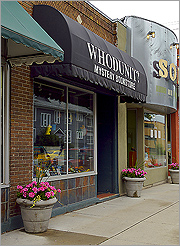
whodunit-storefrontWinnipeg’s only bookstore specializing in crime, thriller and mystery books is 21 years old! Jack and Wendy Bumsted, who have owned the store since 2007, say the 20th birthday slipped by them unheralded. Hence the smashing celebration for the 21st.

Drop by the store on Sunday, November 9th, starting at 2PM for a reception in honour of this milestone. You can roam around the store, refreshments in hand, and buy a few books. There will be a couple of fascinating talks as part of the formal proceedings. Best part of all, from Nov. 8 to 15, everything in the store is 21% off.

You can’t get the kind of service that Whodunit provides at Costco. I read their newsletter from cover to cover as soon as I get it. The reviews and articles by all the Bumsteds–Jack, Wendy, Michael and Sian–have directed me to some terrific books. Personal service, the ability to order in any book, even non-mysteries, great support for local authors, a mystery reading book club and a writer’s group–all make Whodunit indispensable to Winnipeg mystery and thriller fans.

Food, Drink, Books

food plateAh, food. Often book club meetings are as much about the food and drink as about the book. Read the following mouth-watering excerpt from a reply by “Emma”. (See Emma’s entire reply by going to the Oct. 3 post below and clicking on the conversation bubble next to the title.)

Since you asked, probably the best thing about book club is the food and drink! The way our club works is this: the person who chose the book hosts the meeting where we discuss it, and provides the drinks. The previous host brings a dessert, and everyone else brings an appetizer of some sort. (Most of us just have a light supper or skip it entirely in anticipation!) If specific foods are mentioned in the book, often someone will bring that dish or be inspired by it. Or if the book it set in a foreign country or within another culture, that often translates to food choices. (We had a great Indian spread when we read “Secret Daughter”). My last pick was “The Rosie Project” and lucky for me, there was an entire scene in the book that involved bartending, so I made Freddy Fudpucker cocktails and margaritas – yum! We also have one very creative member who will find a way to work a name or theme from the book into her recipe titles, which we all get a kick out of. I know ours isn’t the only book club that jokes that it’s more about the wine than the book — and I think we’re all okay with that. (Not to mention that it’s a welcome evening of adult company sans children!)

Book Clubs Again

stacked books bookplateI was delighted to get the following comment from Verena Unger:

Our book club has been going strong with the same core members (14-16) since 1994.
After trying the usual format for a book club, we ended up with a formula that has worked without fail for us :
– held once a month at the same location (before I moved to Toronto this summer, it was always held at my house and now another member has taken over the hosting of it)
-7-9 p.m.
-we share books, talk about the books that have moved us resulting in our reading books we may otherwise never pick up or know about
– the host supplies the liquids, others bring goodies so we basically have a “dinner” together of sometimes all desserts (and never a complaint, and that’s only happened once or twice I think) but always delicious goodies.
-the gathering is spontaneous. There is no leader and the trust and camaraderie in the group is the best. (But then, it has evolved over all these years).
– women only
That’s basically how our book club functions and I miss it terribly, not having had the opportunity or time to start one here in Hog Town.

Send me more of your book club lore by clicking “reply” below, or the conversation bubble next to the title above, or by going to the “Contact” tab and leaving me a comment.

News of my Whereabouts

Headless Horseman Bookplate

I’m gearing up for the launch of Put on the Armour of Light on Nov. 30 at McNally Robinson. And I thought I would make “portage and slain” the place where you’ll find information about my events in the next few weeks.

If you click on “News” on the banner above, you’ll find that I’ll be giving several talks related to mystery fiction and my book in particular. Also I’ll be giving a reading and signing of the book at the Whodunit bookstore on Dec. 7.